

The “Relocate” Strategy in Boxing: Making Opponents Miss What They Cannot See
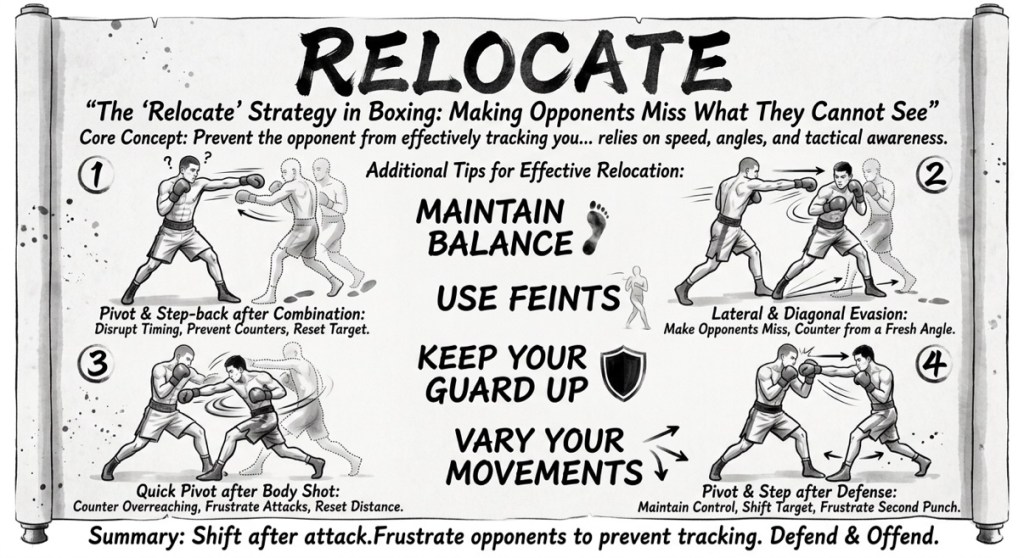
Core Concept:
The idea behind the “relocate” strategy is to use quick, deliberate movements after executing an attack to change your position. This prevents the opponent from effectively tracking you, setting up their counters, or landing their shots. It relies on speed, angles, and tactical awareness to keep the opponent guessing and off-balance.
Examples of the “Relocate” Strategy in Action
Example 1: After a Cross-Hook Combination
A boxer throws a sharp cross followed by a hook to the body or head. Immediately after the combination lands or misses, they pivot on their lead foot and step back or to the side.
Result:
The boxer creates a new angle, making it difficult for the opponent to land a counter punch on the same target.
The opponent’s timing is disrupted, forcing them to reset and re-evaluate their attack.
Example 2: Using Lateral Movement to Evade
During an exchange, if the opponent throws a jab or a right hand, the boxer can slip to the outside or inside, then step diagonally away.
Result:
The opponent’s punch misses its target because the boxer has changed position.
The boxer can then counter from a fresh angle, often with a straight punch or an uppercut.
Example 3: After a Body Shot
A boxer lands a powerful body shot, then quickly pivots and steps back to avoid the opponent’s potential follow-up attack.
Result:
The opponent, expecting a response, may overreach or misjudge the boxer’s positioning.
The boxer can capitalize on this moment to launch a counterattack or reset the fight at a more advantageous distance.
Example 4: After a Defensive Block or Parry
Once blocking or parrying an incoming punch, a boxer can immediately pivot or step to the side to avoid a follow-up punch.
Result:
This quick repositioning makes it more difficult for the opponent to land clean shots, as their target has shifted.
The boxer maintains control of the ring and can then launch their own attack from a different angle.
Additional Tips for Effective Relocation
Maintain Balance:** Always keep a low, balanced stance to pivot smoothly and quickly without losing footing.
Use Feints:** Combine relocation with feints to lure the opponent into predictable counters, then swiftly change position.
Keep Your Guard Up:** After moving, reset your defensive posture to avoid leaving yourself open to counters during the transition.
Vary Your Movements:** Avoid predictable patterns; mix straight backs, lateral shifts, and diagonal pivots to keep your opponent guessing.
Summary
The “relocate” strategy is a powerful tool for maintaining control, creating openings, and frustrating opponents. By quickly shifting position after your attack, you make it difficult for opponents to track your movements and land effective counters. This tactic embodies the principle that “the opponent cannot hit what he cannot see,” turning your movement into a defensive and offensive advantage.

