

“Blocking, slipping, and parrying are all different defensive strategies that boxers can use to protect themselves from their opponent’s punches”
1. Blocking: Blocking involves using your arms and gloves to absorb or deflect your opponent’s punches. You can block punches by raising your arms to cover your head and body, or by using a shoulder or elbow to deflect a punch. Blocking is a basic defensive strategy that allows you to protect yourself from your opponent’s attacks, but it can also be tiring and leave you open to counterattacks.
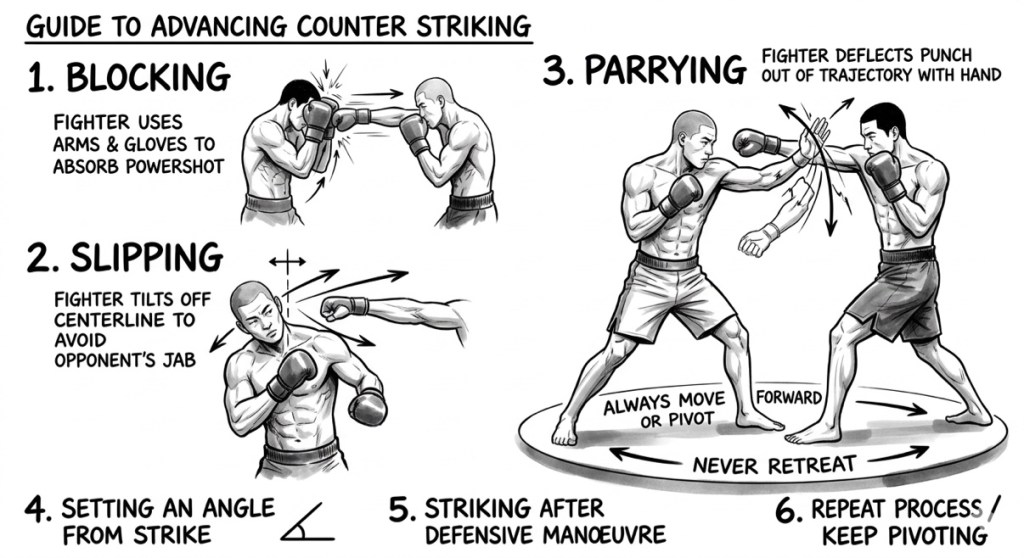
2. Slipping: Slipping involves moving your head off the center line of your opponent’s attack by tilting it to the left or right. This makes it harder for your opponent to land a punch on your head, and also puts you in a position to counterattack. Slipping requires good timing and reflexes, as well as the ability to read your opponent’s movements and anticipate their punches.
3. Parrying: Parrying involves using your gloves or arms to deflect your opponent’s punches away from your body. You can parry punches by pushing them to the side with your gloves or arms, or by using a forearm to block a punch. Parrying is a more advanced defensive strategy that requires good timing and precision, as well as the ability to read your opponent’s punches and react quickly.
In addition to these defensive strategies, boxers also use a variety of offensive strategies to score points and win fights, such as using footwork to move in and out of range, setting up punches with feints and jabs, and targeting specific areas of their opponent’s body. Effective boxing strategies also involve being able to adapt to your opponent’s style and adjust your tactics accordingly, as well as maintaining good physical conditioning and mental focus throughout the fight.
Blocking and parrying drills
- Partner Shadow-Defense Drill: Focus on Blocking and Parrying
Objective: Improve timing, reaction, and technique for blocking and parrying punches.
Setup:
Partner with a focus mitt or light glove holder.
You are the defender; your partner throws controlled punches (jabs, crosses, hooks).
Drill:
The partner randomly throws punches at different speeds and angles.
Your task:
Use blocking to absorb or cover punches, especially head shots.
When appropriate, parry punches by pushing them aside with your glove or forearm.
Focus on smooth, controlled movements without overcommitting.
After 2-3 punches, reset and prepare for the next attack.
Switch roles after 2-minute rounds.
Perform 3 rounds.
Tip: Keep elbows tight, and practice precise timing for parries and blocks.
- Slip and Counter Drill
Objective: Develop head movement, slipping reflexes, and counterattack timing.
Setup:
Partner with light gloves or focus mitts.
You are the slipper; your partner throws punches.
Drill:
The partner throws jabs or crosses at random intervals.
Your goal:
Slip to the left or right just outside the punch’s path.
After slipping, immediately counter with a quick punch (e.g., jab, hook).
Focus on smooth head movement and maintaining balance.
Keep the slips subtle and precise.
Perform 3 rounds of 2 minutes, switching roles.
Variation: The partner can vary punch speed and direction to simulate real fight unpredictability.
- Defense and Movement Combos
Objective: Integrate blocking, slipping, parrying, and footwork into fluid defensive sequences.
Setup:
Use a mirror or coach for feedback.
You can also work with a partner throwing controlled punches.
Drill:
Start in your stance.
The coach or partner throws a series of punches: jab, cross, hook, or combination.
Your response:
Block head or body shots with your arms.
Slip punches to the left or right.
Parry punches to redirect them away.
After each defensive move, step offline or pivot to create angles.
Follow each defensive move with a quick counterattack (e.g., jab, cross, or hook).
Focus on smooth transitions between blocking, slipping, and parrying, integrating footwork.
Complete 3 rounds of 3 minutes.
Tip: Visualize your defense as part of a seamless movement flow, not isolated techniques.

